

Echeveria 'German Champagne' often brings to mind the classic succulent variety, Echeveria 'Champagne.' Your speculation is correct – Echeveria 'German Champagne' is a hybrid derived from Echeveria 'Champagne' that retains some of its characteristics, such as dark markings and farina.
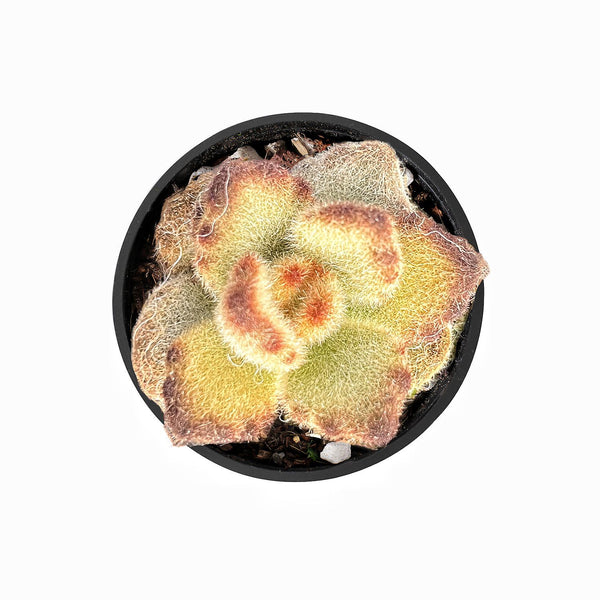
When in average condition, the leaves of Echeveria German Champagne take on a somewhat grayish hue, yet they still clearly display a vibrant "sugar heart" at the center; however, when in peak condition, the overall color palette of Echeveria 'German Champagne' is a captivating light orange-yellow, with a noticeable deepening of color at the plant's center, creating a red succulent sugar heart color – two features that make it one of the most sought-after succulents.
Echeveria 'German Champagne' vs. Echeveria 'Champagne'
Leaf shape: Compared to Echeveria 'Champagne', Echeveria 'German Champagne' features broader and thinner leaves.
Leaf texture: Even before reaching peak coloration, Echeveria 'German Champagne' displays a glossy sheen beneath its farina, resembling the raw, unpolished surface of a freshly mined crystal. In comparison, Echeveria 'Champagne' consistently exhibits a smoother, glossy texture with an almost oily appearance.
Coloration: Without sufficient stress coloration, Echeveria 'German Champagne' typically shows a grayish tone with a distinct dark “sugar-heart” center. Under optimal conditions, however, the foliage develops soft orange-yellow hues paired with a vivid red center, creating a striking contrast. By comparison, Echeveria 'Champagne' usually remains pale green and gradually turns orange when stressed.

How to Care for Echeveria 'German Champagne'
Light
Echeveria 'German Champagne' can adapt to both bright indirect light and filtered sunlight. However, this variety requires strong light exposure—ideally at least 6–8 hours of bright light daily—to develop its signature “sugar-heart” center, which is one of the main reasons many collectors are drawn to this plant. Without sufficient light, its coloration and overall appearance may become far less impressive compared to other Echeveria varieties.

This succulent can be grown outdoors in full sun during spring, autumn, and early winter. During hot summer afternoons, however, providing 50%–70% shade cloth is recommended to prevent heat stress and leaf scorch. For the most vibrant sugar-heart coloration, growing Echeveria 'German Champagne' under grow lights is highly effective. Start with approximately 6 hours of light per day and gradually increase the duration to around 10 hours. Initially, keep the grow light about 12 inches above the plant, then adjust the distance as needed based on the plant’s response.
Temperature
Like other Echeveria succulents, Echeveria 'German Champagne' grows well in temperatures ranging from 41–86°F (5–30°C). It can tolerate brief periods below 41°F, but prolonged cold exposure is risky and may cause frost damage, leaf injury, or rot. Therefore, it is recommended to move the plant indoors before frost arrives or protect it with frost cloth during cold weather.

The ideal temperature range for Echeveria 'German Champagne' to thrive is around 50–77°F (10–25°C). The natural temperature differences between day and night in spring and autumn are especially beneficial for stress coloration, helping trigger its signature vivid red “sugar-heart” center.
When temperatures remain above 86°F (30°C) for several consecutive days, providing shade becomes essential. Excessive heat and intense sunlight can overheat the moisture stored inside the leaves, resulting in leaf damage, cracks, or permanent scars.
Watering
The “soak and dry” watering method works very well for Echeveria 'German Champagne'. This means watering the plant only when the potting soil has dried out completely. You can check the soil moisture by inserting your finger or a wooden chopstick into the soil. During spring and autumn, watering is typically needed every 5–7 days, depending on climate and airflow.
Watering Echeveria 'German Champagne' requires extra care during summer and winter, as this variety is especially prone to rot when watered improperly in hot conditions. There are four important summer watering tips to remember. First, water only after sunset on sunny days. Second, bottom watering is generally safer than top watering, as it helps prevent excess moisture from remaining in the crown. Third, provide excellent ventilation after watering to improve evaporation and reduce the risk of fungal problems. Fourth, remember to pour the excess water on the trays after watering or rain. Keeping these four practices in mind can help prevent many common watering issues.
Winter watering is slightly different. In most cases, keeping the plant completely dry is the safest option. However, if the succulent shows signs of severe dehydration, such as wrinkled or withered leaves, you can apply a small amount of water along the inner edge of the pot, avoiding direct contact with the root ball. Always do this on a warm, sunny day to ensure the succulents can drink the light moisture slowly instead of getting disturbed by potential frost shock.
Soil and Pot
Opt for well-draining soil, a mix of perlite, pumice, and succulent potting mix in a 2:1:1 ratio. Choose a succulent pot with drainage holes at the bottom.
Pest Control
It has been observed that Echeveria 'German Champagne' rarely suffers from pests or diseases. The most common and serious issue is root rot, usually caused by excess humidity or overwatering, which can quickly damage the plant.
If mealybugs or other scale insects appear, you can follow this guide to find a suitable solution:
How to Use Neem Oil on Your Succulents and Cactus
Propagation
Leaf propagation is the most common method for Echeveria 'German Champagne', although the success rate is generally lower compared to other Echeveria varieties. Unfortunately, this beautiful succulent rarely produces offsets or pups, so propagating Echeveria German Champagne often requires more effort and patience.
There is another blog on succulent leaf propagation that may help you avoid common mistakes:
Avoid These 8 Common Pitfalls for Success!
Conclusion
Echeveria 'German Champagne', a beloved succulent variety, amalgamates the allure of rare succulents with the ease of low-maintenance care. This guide is your key to unlocking the full potential of your Echeveria 'German Champagne'.







1 thought on “How to Care for Echeveria 'German Champagne'”