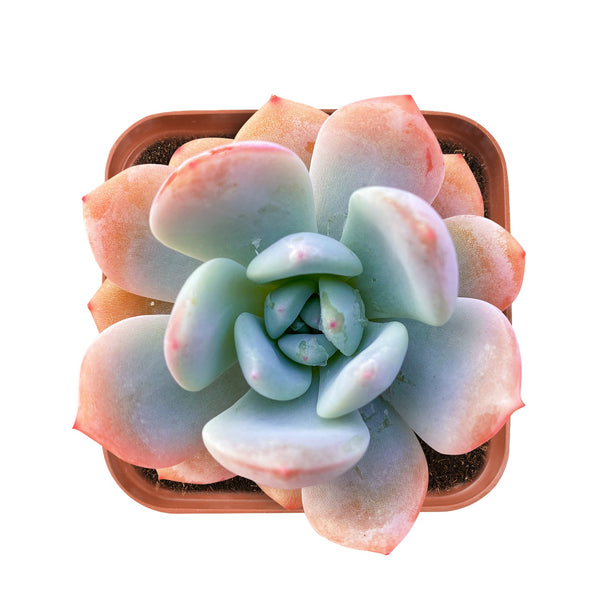
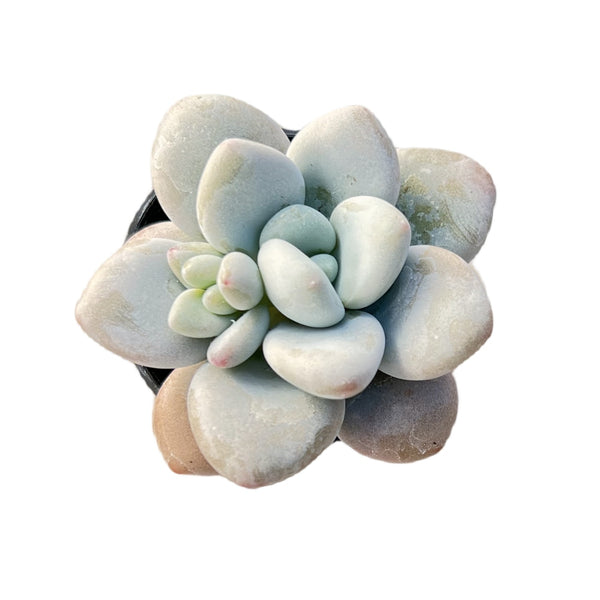
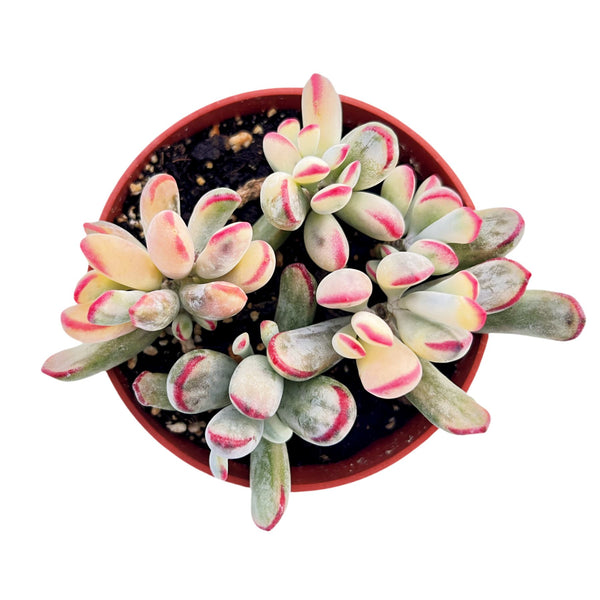
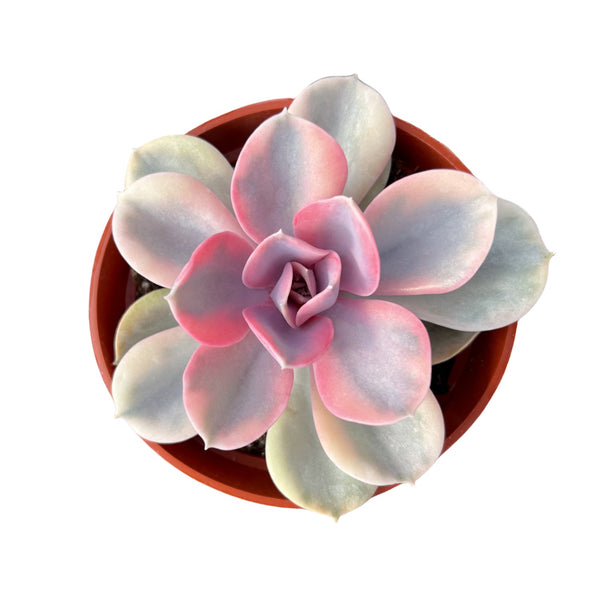
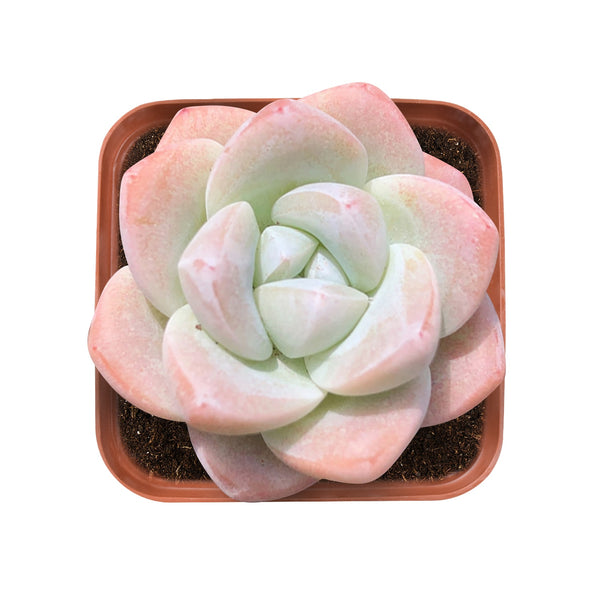
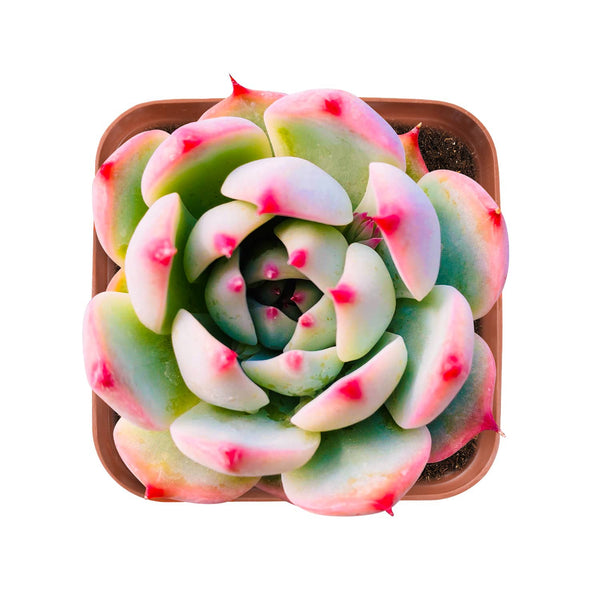
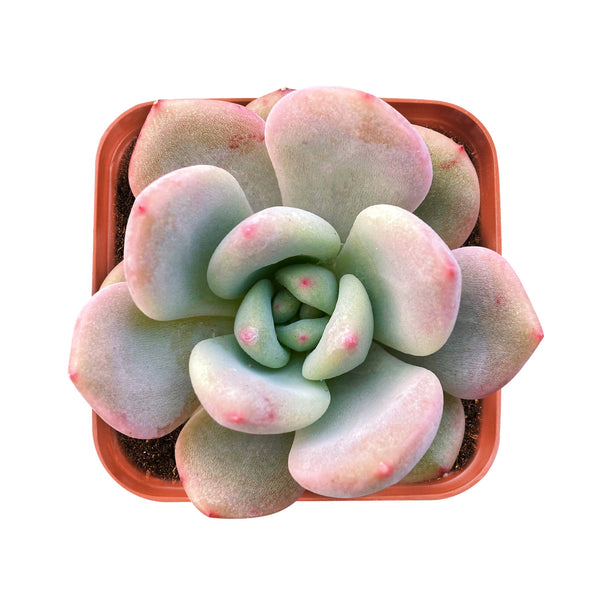
Echeveria 'Ice Green' is a succulent plant in the family Crassulaceae. And the rare succulent is a hybrid of Echeveria elegans and Echeveria Lauii.
Echeveria 'Ice Green' has always been popular with succulent enthusiasts. Its chubby triangular leaves cluster together, forming a tightly packed rosette. This petite succulent variety boasts a slow growth rate, resisting yellowing and elongation. The triangular leaves feature a pronounced convexity on the back, and when paired with the thick farina of Echeveria 'Ice Green', they create stunning patterns.

In its prime, Echeveria 'Ice Green' takes on a vibrant orange hue, complementing its translucent leaves. Some liken it to jelly, while others see it as jade. In any case, it undergoes a remarkable transformation, setting it apart from its previous green state.
How to Take Good Care of Echeveria Ice Green
When it comes to Echeveria 'Ice Green', having just one is far from satisfying – you'll find yourself yearning for more. Especially when you've cultivated a radiant Echeveria 'Ice Green', trust me, you can never anticipate the sheer beauty your next one will unveil.

For those new to the world of succulents, tending to Echeveria 'Ice Green' may pose a few challenges. If you find yourself facing hurdles in the care process, don't miss out on the insights shared in this care guide for Ice Green:
1. Watering
Echeveria 'Ice Green' has a specific water storage capacity, so like most succulents, it is relatively drought-tolerant. Building upon the Soak and Dry watering principle, here are crucial tips to enhance your care routine for Echeveria 'Ice Green':
- 1. Wait until the soil is completely dry, then observe the bottom three layers of leaves on your Echeveria 'Ice Green.' Begin watering when they start to feel soft.
- 2. Avoid pouring water directly onto the leaves of your Echeveria 'Ice Green.' Opt for bottom watering to prevent undesirable conditions.
- 3. After watering, especially in summer, ensure proper air circulation. Using a fan to maintain ventilation becomes crucial for your succulent.
In winter, the water evaporates very slowly, about once a month or so. If the room temperature is below 32 ℉, stop watering; the soil moisture will freeze the Echeveria 'Ice Green' roots.
2. Lighting
Ever wondered why your Echeveria 'Ice Green' hasn't unveiled its expected vibrant hues? The answer lies in the quest for light. Echeveria 'Ice Green' craves abundant sunlight to showcase its true colors.

During spring and fall, place your Echeveria 'Ice Green' outdoors, ensuring it basks in plentiful direct sunlight. While the summer afternoon sun can be intense and potentially scorch the leaves, providing some shade becomes crucial.
Opt for a sunlit windowsill or utilize a growth lamp when caring for Echeveria 'Ice Green' indoors. Aim for a light exposure of 12-16 hours.
If your Echeveria 'Ice Green' has lingered in the realm of green, fret not. Offer it the light it craves, be patient, and within 6-12 months, you're bound to witness the delightful surprise of your Echeveria 'Ice Green' revealing its true, enchanting colors.

3. Soil and Pot
The delicate root system of Echeveria 'Ice Green' is prone to distress, especially when buried in dense soil that hinders its ability to breathe, leading to root rot. This could be one of the reasons why your Echeveria 'Ice Green' continues to struggle.
To combat this issue, our seasoned gardeners recommend a soil blend comprising 20% peat soil and 80% granular material. This soil mix guarantees optimal drainage and aeration for the succulent's roots.
When selecting a pot, steer clear of excessively large or tall containers, as they often demand more soil, leading to prolonged moisture retention after watering—a perilous condition for the fragile roots of Echeveria 'Ice Green'. Opt for containers with an appropriate height and a wider diameter for a healthier growing environment.

4. Fertilize
Don't fertilize too frequently when raising 'Ice Green,' and occasionally, you can use some thin liquid fertilizer or nutrient solution (be sure to dilute it with water more than 1000 times).
Of course, if conditions permit, you can use milder organic fertilizers such as sheep manure, which can prevent soil compaction and provide balanced nutrition, which is more conducive to the health and growth of 'Ice Green.'
How to Propagate Echeveria Ice Green
Leaf cuttings are the most popular method of propagation. First, twist the leaf from the parent succulent and then put the leaf in a cool and dry environment for 1-2 days. After the end of the leaf dry, place them face up under the soil. After moistening the surface soil, put it in a ventilated environment for about seven days, and you will see new shoots grow. Click here to learn how to propagate succulents from leaves.

Why Echeveria ‘Ice Green’ Suffers from Rot: The Real Cause Behind Plant Failure
Echeveria ‘Ice Green’ is often considered a beautiful but somewhat sensitive succulent, especially among beginners. Most of them say the plant “dies from rot.” In reality, rot is the outcome of prolonged environmental stress—most commonly caused by excessive moisture combined with heat and poor ventilation.
The primary trigger is overwatering, especially when the soil remains wet for too long. Succulents like Echeveria ‘Ice Green’ store water in their thick leaves, meaning they are naturally adapted to dry conditions. When the root system is constantly exposed to moisture, it begins to weaken, lose oxygen, and eventually break down. Sometimes, somehow fortunately, you may not lose the entire plant. Instead, the leaves may develop cracks or “break marks,” which are also commonly caused by a combination of overwatering and excessive sun exposure.
In summer, the risk becomes even higher. High temperatures combined with stagnant air can create a humid micro-environment around the plant and inside the soil. This accelerates bacterial activity and fungal growth, making root collapse much more likely—even if watering behaviors seem reasonable.
Poor ventilation is another overlooked factor. Without airflow, moisture cannot evaporate efficiently, and the soil stays damp longer than expected.
For this reason, successful cultivation of Echeveria ‘Ice Green’ depends less on strict watering schedules and more on environmental control: fast-draining soil, proper airflow, seasonal watering adjustment, and avoiding excess moisture during hot periods. When these conditions are balanced correctly, rot can be almost completely prevented, and the plant will maintain its compact, healthy form.
Echeveria Ice Green vs Echeveria Elegans
I was asked by some growers of how to identify Echeveria Ice Green and Echeveria Elegans. No doubtly they must belong to succulent beginners. Although Echeveria ‘Ice Green’ and Echeveria ‘Elegans’ share some visual similarities, there are still clear differences between them.
Echeveria elegans and its related hybrids typically have thinner leaves, with the underside forming a smooth, semi-circular curve. When properly stressed, the plant tends to grow into a tightly wrapped, ball-like form, as seen in varieties such as Echeveria elegans ‘Mexican Snowball’. In contrast, Echeveria ‘Ice Green’ has noticeably thicker leaves and a more structured, angular rosette form.

Their coloration also differs. Echeveria elegans can shift from pale green or blue-green to soft pink or orange tones under stress. Echeveria ‘Ice Green’, however, often displays a more translucent, jelly-like texture when growing vigorously, and its coloration is generally more variable and less predictable compared to Echeveria elegans.