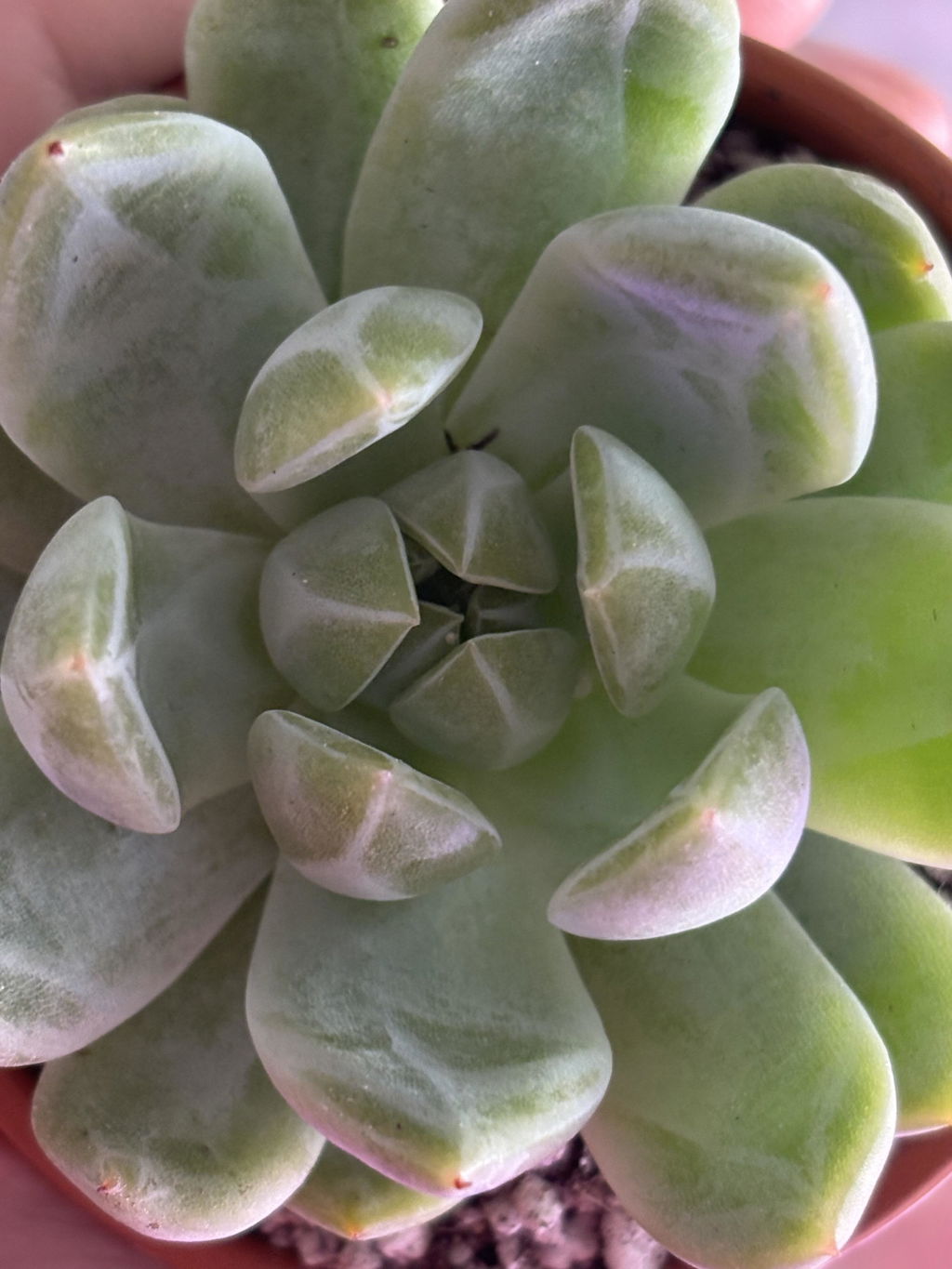
Aeonium ‘Medusa’ is a variegated sport (mutation) derived from Aeonium ‘Velour’, which itself is known for its rich purple tones and velvet-like leaf texture. When ‘Velour’ developed variegation, it eventually formed this striking cultivar we now call ‘Medusa’. Compared with other popular variegated Aeoniums such as Aeonium ‘Superbang’ and Aeonium ‘Pink Witch’, many growers agree that Aeonium ‘Medusa’ has the most intense and vivid coloration. The "standard" Aeonium Medusa features a dark, almost black-purple center stripe on its leaves.

However, while Aeonium ‘Medusa’ is undeniably beautiful, it is also known to be less stable than many other Aeoniums. If it stays in a low-light environment for too long, or if it experiences prolonged drought stress, it may "revert" to its original form—losing its colorful edges and turning back into a standard, solid-colored purple or green Aeonium. Growing Aeonium ‘Medusa’ successfully requires a more thoughtful balance of light, water, airflow, and seasonal care.

This guide will walk through everything you need to know to keep Aeonium ‘Medusa’ healthy, colorful, and thriving year-round.
Lighting
Lighting is the most critical factor in determining the visual quality of Aeonium ‘Medusa’. Aeoniums are "color-shifters"; their pigments change based on the intensity and duration of UV exposure.
The Sweet Spot: Bright Indirect Light
While some succulents crave the harshest desert sun, Aeonium Medusa is more delicate due to the lack of chlorophyll in its variegated (yellow/red) leaf margins. Direct, scorching afternoon sun can lead to permanent scarring or sunburn.
The Goal: Provide bright, filtered light that encourages the production of anthocyanins (the red/purple pigments) without burning the plant.
Indoor Care: For indoor cultivation, place the Aeonium ‘Medusa’ on a bright East or West-facing windowsill. These orientations provide high-quality light without the extreme heat of midday. If using a South-facing window, a sheer curtain is required during the summer peak. This protects the variegated leaf margins—which lack protective chlorophyll—from thermal damage and sun-bleaching while ensuring the plant receives enough UV light to maintain its intense red and black pigmentation.

Outdoor Care: Outdoor light requirements for the Aeonium ‘Medusa’ shift with the seasons. Full-day or half-day sun is ideal during the active growth periods of spring and autumn. A 50%–70% shade cloth provides the necessary UV protection during peak heat. Ideally, these plants should be situated in the dappled shade of a larger tree canopy—a landscaping technique widely popularized in the California Bay Area. This positioning ensures Aeonium Medusa receives enough light to maintain its variegation without risking the structural integrity of its foliage.

Soil and Potting
The quickest way to kill an Aeonium ‘Medusa’ is through "wet feet." Their root systems are relatively shallow and susceptible to fungal pathogens if the soil remains damp for too long.
The Particle Ratio
For a professional-grade potting mix, you must prioritize mineral content. A high ratio of inorganic material (grit) ensures that oxygen reaches the roots.
Cooler Climates: Use a ratio of 60%–70% granular material (pumice, lava rock, perlite, or akadama) and 30%–40% high-quality succulent soil.
Humid Climates: Increase the grit to 70%–80%. In humid environments, soil stays moist for longer through atmospheric absorption, so a higher mineral count is vital to prevent rot.
Choosing the Right Pot
The size of the pot should be proportional to the plant’s stem height and rosette diameter:
Small/Young Plants (Stem <10cm): Use a pot with a depth no greater than 20cm.

Mature Specimens: Larger plants have more robust stems that store water; the pot size is more flexible to choose from. However, always prioritize breathable materials like terracotta or unglazed ceramic. These materials allow for "lateral evaporation," helping the soil dry out more evenly.
Watering
Unlike many thick-leaved succulents, such as Echeverias or Haworthias, that store vast amounts of water in their leaves, Aeonium succulents possess a higher metabolic demand for moisture during their active growth cycles. Their thinner leaf structure and higher transpiration rates mean they require more frequent watering to maintain leaf turgor and support the rapid stem elongation.
Spring and Autumn: The Active Seasons
During these periods, Aeonium Medusa is hungry for hydration.
Frequency: Approximately once every 7–10 days, depending on your local humidity.
Technique: Use the "soak and dry" method. Wait until the soil is about 70%–80% dry, then water thoroughly until it drains out of the bottom.
Rainwater: Aeonium Medusa loves rainwater. If the weather is mild and it’s raining, feel free to let your plant sit outdoors. The natural acidity and nitrogen in rainwater often trigger a growth spurt and the emergence of new offsets.

The Summer Dormancy: The Danger Zone
When temperatures consistently rise above 86°F (30°C), Aeonium Medusa will enter dormancy state. The stems may get bold, and the rosette will curl inward.
Stop Deep Watering: If you give a dormant Aeonium Medusa a "big drink" in the heat of July, the roots will likely rot because they are not actively drinking.
Maintenance Sips: Water only approx every 20 days. Pour a small amount of water around the inner edge of the pot—just enough to keep the fine root hairs from completely desiccating, but not enough to saturate the core of the root ball.

Fertilization: Less is More
Because Aeonium Medusa is a slow-to-moderate grower, it does not require heavy feeding. Over-fertilizing can actually cause the plant to grow too quickly, resulting in weak stems and "bloated" leaves that are more prone to pests.
When to Fertilize: Only during the peak growth months of Autumn and Spring.
What to Use: A low-nitrogen, slow-release fertilizer is best. You can simply sprinkle a few granules on the soil surface. Alternatively, use a diluted liquid seaweed extract or a cactus fertilizer based on the recommendation once a month.

Pest Management: The Mealybug War
The tight, overlapping leaves of Aeonium Medusa rosette provide the perfect hiding spot for Mealybugs. These white, cotton-like insects suck the sap from the plant, causing leaf deformity and potentially introducing viruses.
Prevention: The best defense is a clean environment and prevention. Every 3 months, apply a systemic insecticide (like imidacloprid granules) to the soil.
Treatment: If you see a pest, use a cotton swab dipped in 70% isopropyl alcohol to dab them away. For larger infestations, a neem oil spray can be used, but caution is required: never apply oils in direct sunlight, as the oil will act as a magnifying glass and fry the variegated leaves.
Propagation
One of the most rewarding aspects of Aeonium Medusa is its prolific "pupping" habit. Once a plant reaches about 18 months of age, it will naturally begin to produce side branches from the main stem.

Natural Branching
In the spring, you will notice tiny green and red nubs emerging from the leaf axils. While some of these may be "absorbed" by the plant if resources are low, most will grow into full branches. This creates the "Medusa head" look.
Stem Cuttings
If you want to create a new plant:
1. Use a sterilized blade to cut a mature offset.
2. Allow the cutting to "callus" (dry out) in a cool, shaded area for 3–5 days.
3. Place the cutting into a very gritty, dry mix.
4. Do not water until you see resistance when you gently tug the plant (signaling root growth), usually after 2–3 weeks.

Strategic Acquisition: Why Autumn is the Golden Window
If you are looking to add an Aeonium ‘Medusa’ to your collection, timing your purchase is vital.
I strongly recommend buying your Aeonium Medusa in the Autumn. Here is why:
● Establishment Time: By purchasing in Autumn, the plant has the entire Winter and Spring to establish a powerful root system while the weather is cool.
● Summer Readiness: A plant that has been in your care for 6–8 months will be much "stronger" by the time the grueling summer heat arrives.
● Shipping Safety: Aeoniums do not ship well in high heat; their leaves bruise easily, and they can "steam" in a cardboard box. Autumn shipping ensures the plant arrives in peak condition.
Troubleshooting Common Issues
Leaf Dropping
It is normal for the bottom leaves of an Aeonium to dry up and fall off. This is how the plant creates its woody trunk. However, if the plant drops healthy leaves from the middle of the rosette, it is likely a sign of overwatering or extreme temperature shock.
Loss of Variegation
If your Aeonium Medusa is turning entirely purple or green, it is shouting for more light. Slowly move it to a brighter location over the course of two weeks to re-establish its colors.
Soft, Mushy Stem
This is the dreaded "Stem Rot." If the base of the stem is black and soft, you must act fast. Cut the top "head" off well above the rot, ensure the cross-section of the stem is clean and white, and try to re-root it as a cutting.

Conclusion
By balancing the high mineral content of its soil with careful, seasonal watering and filtered sunlight, you will be rewarded with an Aeonium Medusa succulent that looks like it stepped out of a mythological dream. Whether you are a seasoned "succulent-phile" or a dedicated hobbyist, Aeonium Medusa remains one of the most rewarding challenges in the world of indoor and outdoor gardening.